20140911

Photos of 'Yeti Footprints' Hit the Auction Block


Ardent believers in the existence of a mythical creature known as the Yeti may be excited to learn that rare photographic "evidence" of this mysterious beast is now up for auction.

In 1951, British mountaineer Eric Earle Shipton was leading an expedition on Mount Everest when he took a series of photographs of what he believed might be the footprints of a bipedal, apelike creature known as the Yeti. The photos sparked debate in Europe about the existence of themythical Himalayan creature, according to Christie's, the auction house handling the online sale.
Four of Shipton's 12-inch by 13-inch (30 by 33 centimeters) photographs will be sold to the highest bidder in a two-week-long online auction that began on Aug. 27. Two of the photos feature the alleged Yeti footprints alongside human footprints for the sake of comparison. The other two photos give the viewer a better sense of the scale of these enigmatic prints — showing the Yeti footprint next to an ice ax and a booted foot, respectively. [ See more photos of the supposed Yeti footprints ]


CHRISTIE'S IMAGES LTD. VIA LIVESCIENCE
Four photos depicting the supposed footprints of a mythical creature known as the Yeti are currently for sale online.

The 63-year-old photos could fetch up to $8,300, according to Christie's.
Other highlights from the " Out of the Ordinary: The Online Edit " auction include an iguanodon vertebrae fossil from the early Cretaceous period. The bidding for this ancient prize starts at $829. An egg from an extinct species of elephant bird (Aepyornis maximus) from Madagascar will likely cost more, with a starting bid set at $10,000.
For science-fiction fans, the online auction also features an original poster from the 1958 film "I Married a Monster from Outer Space" (which could fetch $3,975). However, a bolder choice may be the full-size replica of the extraterrestrial creature from the 1979 film "Alien." Expected to sell for at least $4,000, the replica was one of 100 models that were used to create alien costumes for the iconic film.
And, of course, there's something for space fans, too. Christie's is also auctioning off a fragment of the Bible that accompanied American astronaut Edgar D. Mitchell to the moon during the Apollo 14 mission in February 1971. The specimen could sell for $16,500, according to the auction house.

20140902

High-Flying Radar Uncovers Hidden Faults After Napa Earthquake

The Aug. 24 Napa earthquake woke several small, previously unrecognized Napa Valley faults, according to the first results from a high-flying NASA radar instrument. The magnitude-6.0 Napa earthquake, the biggest to shake northern California in 25 years, injured 170 people and killed one woman. Most of the damage was centered on the West Napa Fault. The U.S. Geological Survey (USGS) found that the West Napa Fault moved a total of 18 inches (46 centimeters) along a 9.3-mile-long (15 kilometers) length, USGS scientist Dan Ponti said Sept. 4 at a USGS earthquake seminar. New radar images of Napa Valley also confirm that the West Napa Fault caused the deadly earthquake.

But the images also reveal a handful of smaller faults running roughly northwest to southeast, parallel to the West Napa Fault. "These really tiny ones are probably not big enough faults to have a significant earthquake, but it's a good thing to have people go out and check whether they are part of a larger fault system," said Eric Fielding, a geophysicist at NASA's Jet Propulsion Laboratory (JPL) in Pasadena, California. The radar images were created from UAVSAR (uninhabited aerial vehicle synthetic aperture radar) data collected during flights on May 29, 2014, and on Aug. 29, 2014.


Image: Ground deformation from the Aug. 24 earthquake in Napa, CaliforniaNASA / JPL-CALTECH / ASI / GOOGLE EARTH
Ground deformation from the Aug. 24 earthquake in Napa, California. Each color fringe corresponds to deformation of 4.7 inches (12 centimeters).
Image: Ground deformation from the Aug. 24 earthquake in Napa, California

20140901

2d Hologram?

Physicists at Fermilab in Illinois have turned on a laser-based experiment that could reveal whether the three-dimensional world we perceive is merely a "Matrix"-style illusion generated by a cosmic two-dimensional hologram.
The Holometer experiment is the result of years of work by particle astrophysicist Craig Hogan and his colleagues at the federally funded Fermi National Accelerator Laboratory, and it could provide the first clear evidence for the existence of the holographic universe. The concept has been debated fordecades, but it's devilishly difficult to show whether it can ever be anything more than a concept.
Hogan aims to find out whether the universe is a hologram by looking for telltale quantum jitters in the fabric of space-time itself. "If we see something, it will completely change ideas about space we've used for thousands of years," he said in a news release.

Image: HolometerREIDAR HAHN / FERMILAB
A photo taken with a wide-angle lens from above shows the heart of the Holometer as a Fermilab researcher works on the apparatus.

The Holometer — short for "holographic interferometer" — consists of two interferometers, each of which fires a 1-kilowatt laser beam at a beam splitter, and then down two perpendicular 130-foot (40-meter) arms. The laser light is then reflected back to the beam splitter and recombines. If the splitter has moved slightly due to jitters in the space-time continuum, subtle fluctuations in the light should reveal the effect.
The apparatus is moving all the time, of course — but the Holometer is tuned to detect differences on the scale of less than a millionth of a second. Scientists should be able to filter out the effects of physical motion as well as radio noise from the electronics in the lab.
"If we find a noise we can’t get rid of, we might be detecting something fundamental about nature — a noise that is intrinsic to space-time,” said Fermilab physicist Aaron Chou, lead scientist and project manager for the Holometer. "It's an exciting moment for physics. A positive result will open a whole new avenue of questioning about how space works."
How space-time (might) work
The traditional view is that our universe has three spatial dimensions, with time serving as the fourth dimension. String theorists say the equations that govern quantum mechanics and gravity become more elegant if the universe has six or seven additional dimensions. Physicists will be looking for evidence of those higher dimensions when Europe's Large Hadron Collider starts up again next year.
Image: Holometer
Image: Holometer

Ancient 'Dragon' Pterosaur Flew Right Out of 'Avatar'

A sprawling ancient flying reptile looked so much like a dragon that could have flown with the aerial predators called "ikran" in the film "Avatar" that its discoverers named the newfound beast after those mountain banshees.

The pterosaur, dubbed Ikrandraco avatar ("draco" means "dragon" in Latin), may have stored food in a throat pouch like a pelican does, the researchers said.
Pterosaurs were the first vertebrates to flap wings to fly. Before pterosaurs went extinct in the catastrophic impactthat ended the Age of Dinosaurs, they were the biggest animals that ever flew, with wingspans measuring up to 39 feet (12 meters). (Although pterosaurs lived alongside dinosaurs, these flying reptiles were not dinosaurs.)

Image: IkrandracoCHUANG ZHAO
The pterosaur known as Ikrandraco avatar may have stored food in a throat pouch similar to a pelican's.
Image: Ikrandraco

Scientists investigated two partial skeletons of Ikrandraco dating back about 120 million years, to the Early Cretaceous Period. They unearthed these fossils in arid hills in northeastern China's Liaoning province, which has become famous for the trove of feathered dinosaurs unearthed there over the last decade. Back when this reptile was alive, the area where it was found was a large freshwater lake. [Images of Pterosaurs: Flight in the Age of Dinosaurs]
Image: Ikrandraco
The pterosaur was about 2.3 feet (0.7 meters) long and had a wingspan of about 4.9 feet (1.5 meters). It had an elongated skull and a unique crest or bladelike bulge of bone on the tip of its lower jaw. The head of this newfound pterosaur is similar to that of the ikran in "Avatar," said lead study author Xiaolin Wang of the Chinese Academy of Science's Institute of Vertebrate Paleontology and Paleoanthropology.
The back of Ikrandraco's jaw crest had a little hooklike structure. The researchers suggested this notch may have served as an anchor for soft tissue, and they proposed that Ikrandraco had a throat pouch like the one a pelican uses to store food.
The researchers plan to conduct experiments to see whether Ikrandraco's jaw crest could have supported a throat pouch. The scientists detailed their findings online Thursday inScientific Reports.

20140827

Mind Reading? Brain-to-Brain Message Sent From India to Paris

In an experiment that sounds more like science fiction than reality, two humans were able to send greetings to each other using only a digital connection linking their brains.

Using noninvasive means, researchers made brain recordings of a person in India thinking the words "hola" and "ciao," and then decoded and emailed the messages to France, where a machine converted the words into brain stimulation in another person, who perceived the signals as flashes of light. From the sequence of flashes, the French recipient was able to successfully interpret the greetings, according to a new study published Friday (Sept. 5) in the journal PLOS ONE. [Inside the Brain: A Photo Journey Through Time]
The researchers wanted to know if it is possible for two people to communicate by reading out the brain activity of one person and injecting that activity into a second person.

Image: Brain-to-brain linkPLOS ONE
Credit: Thinkstock
Credit: Thinkstock
Credit: Thinkstock
Using the brain link, a person in India transmitted greetings to people in France, using thoughts alone.

"Could we develop an experiment that would bypass the talking or typing part of [the] Internet and establish direct brain-to-brain communication between subjects located far away from each other, in India and France?" co-author Dr. Alvaro Pascual-Leone said in a statement. Pascual-Leone is a neurologist at Beth Israel Deaconess Medical Center in Boston, and a professor at Harvard Medical School, in Cambridge, Massachusetts.

20140814

Mysterious Mushroom-Shaped Deep-Sea Creatures Found off Australia

Mysterious animals discovered offshore Australia resemble floppy chanterelle mushrooms but feel like dollops of gelatin, according to a new study.

The ocean-dwelling creatures are so unusual that an entire new taxonomic family was created to classify them, scientists report today (Sept. 3) in the journal PLOS ONE. Yet nothing is known about their lifestyle, their feeding habits, how they reproduce or if they float or attach to the seafloor.
"We don't even know if they're upside down," said lead study author Jean Just, a taxonomist at the Natural History Museum of Denmark.


Image: Photographs of 15 Dendrogramma specimensJEAN JUST / PLOS ONE
Photographs of 15 Dendrogramma specimens. The ocean-dwelling creatures are so unusual that an entire new taxonomic family was created to classify them.
Image: Photographs of 15 Dendrogramma specimens

The two new species described in the study were officially named Dendrogramma enigmatica and Dendrogramma discoides. Their tops are flat discs about 0.5 inches (about 1 centimeter) wide. Inside the discs, a fan of digestive tubes delivers nutrients, radiating outward like bicycle tire spokes. The center "mouth" opens into the stalk, and is probably for both eating food and excreting waste, Just said. (Many primitive species have this single gut.) Of the two new species, one has a shorter stalk and smaller disc compared with the other, though the difference is only a few millimeters. [ Image Gallery: Mysterious Ocean-Dwelling 'Mushrooms' ]
Image: Photographs of 15 Dendrogramma specimens

20140805

A Lost-and-Found Nomad Helps Solve the Mystery of a Swimming Dinosaur

The first bones came in a cardboard box. Nizar Ibrahim, a paleontologist, was in the Moroccan oasis town of Erfoud at the edge of the Sahara, returning from a dinosaur dig in the sands. Inside the box, brought to him by a nomad, were sediment-encrusted pieces more intriguing than anything he had found himself, including a blade-shaped bone with a reddish streak running through the cross section. He took the bones to a university in Casablanca.

The next year, he was in Italy visiting colleagues at the Milan Natural History Museum who showed him bones that seemed to be from Spinosaurus aegyptiacus, a strange-looking predatory dinosaur larger than Tyrannosaurus rex that lived in northern Africa about 95 million years ago.
He looked at the spines, part of a giant distinctive sail on the back of Spinosaurus. He saw a familiar red line — possibly a passageway for blood vessels long since decayed away — in the cross section of a bone. “My mind started racing,” he said.
Photo

An artist's interpretation of how Spinosaurus aegyptiacus might have looked and how its size might have compared with that of a human. CreditDavide Bonadonna
Amazingly, the pieces in Milan and those he had seen a year earlier and 1,200 miles away were from the same ancient skeleton.
That was the start of an odyssey of diligence and serendipity that led to the unveiling on Thursday of a new skeleton of Spinosaurus. The largest known predatory dinosaur, growing to at least 50 feet in length, Spinosaurus is also the only dinosaur known to be a swimmer that spent a large fraction of its life in the water.
“It’s probably the most bizarre dinosaur out there,” said Dr. Ibrahim, a graduate student when he saw the first bones, and now a postdoctoral researcher at the University of Chicago.
Spinosaurus had been an intriguing mystery for decades. The original fossil of the dinosaur, discovered in Egypt a century ago and moved to a German museum, was destroyed during World War II, leaving paleontologists with little more than a few drawings to ponder.
The new partial skeleton is of a Spinosaurus not fully grown, about 36 feet long. Its forelimbs were large and strong, with scythe-like claws; its hind legs were short, with paddle-shaped feet.
In an article published online on Thursday by the journal Science, Dr. Ibrahim and an international team of colleagues describe the features that made the dinosaur well suited for swimming and feasting on giant fish that lived in the rivers there.
Conical teeth in a crocodilian snout overlapped like a snare for trapping fish, and it had nostrils halfway up the skull so it could stick its snout into the water and still breathe.
With its flat feet, Spinosaurus may have paddled like a duck. It had a long, flexible tail, which it may have used for propulsion. “It’s like a cross between an aquatic bird and a crocodile,” 

said Paul C. Sereno, a paleontologist at the University of Chicago who was part of the research team.
On land, Spinosaurus was ungainly. The researchers calculated that its center of mass would have been too far forward for it to have stood easily on its hind legs, like other predator dinosaurs; instead, it ambled on all four legs.
“It does add significantly to the strangeness,” said Matthew C. Lamanna, a paleontologist at the Carnegie Museum of Natural History in Pittsburgh, who was not involved with the research. He described the evidence for Spinosaurus’s semiaquatic existence as “quite convincing.”
Photo

A life-size model of Spinosaurus aegyptiacus made from polystyrene, resin and steel. The model was created from computer scans of fossils, images of lost bones and educated guesses using bones from related dinosaurs. CreditMike Hettwer/National Geographic
An exhibition on Spinosaurus opens Friday at the National Geographic Museum in Washington. The National Geographic Society provided financing for the research.
The new findings may return prominence to Ernst Stromer, the German paleontologist who first described Spinosaurus aegyptiacus, meaning “Egyptian spine lizard.”
Stromer’s fossil, mounted in the Bavarian State Collection of Paleontology in Munich, included the lower jaw and parts of the spine.

In April 1944, the British Royal Air Force dropped a bomb on the museum, and Spinosaurus — and every Egyptian dinosaur fossil known at the time — burned.
After that, some isolated bones of Spinosaurus were found, but nothing as complete as Stromer’s specimen. Some evidence, like the conical teeth, suggested Spinosaurus ate fish, but perhaps it just waded into a river and caught them like a grizzly bear.


An artist's interpretation of how Spinosaurus aegyptiacus might have looked and how its size might have compared with that of a human. 
Credit
Davide Bonadonna

One fossil, uncovered in Morocco around 1975, had been thought to be part of the lower jaw of a crocodile, but a decade ago, Cristiano Dal Sasso of the Milan museum realized that interpretation was upside down. “There were too many bones to be the lower jaw,” he said.
It was actually from the top half of a snout of a huge adult Spinosaurus.
In 2008, an Italian geologist showed the new Spinosaurus bones to Dr. Dal Sasso, who then showed them to Dr. Ibrahim.
But the scientists were missing crucial geological information about where the bones had been excavated.
Dr. Ibrahim needed to find the nomad, so last year, he returned to the Erfoud area.


Photo

A life-size model of Spinosaurus aegyptiacus made from polystyrene, resin and steel. The model was created from computer scans of fossils, images of lost bones and educated guesses using bones from related dinosaurs. 
Credit
Mike Hettwer/National Geographic

20140626

Magnesium and Memory...

Magnesium Supplements Could Improve Memory and Cognitive Ability

November 1, 2012
brain-boost
After a decade of research hinting that magnesium supplements could potentially boost your memory and cognitive abilities, it’s finally being put into a small clinical trial. The research is being led by the biopharmaceutical company Magceutics, of Hayward, California, and they began testing the ability of their supplement Magtein to boost magnesium ion levels in the brain.
The trial will track whether the ions can decrease anxiety and improve sleep quality, as well as see if there are changes in memory and cognitive ability in the participants. The trial only has 50 people, so any results won’t allow scientists to draw definite conclusions.
Eventually, they will also test if Magtein can be used to treat ADHD and Alzheimer’s disease. Many scientists are skeptic about this small trial and whether it will be able to prove anything conclusively. So far, the product has been mostly tested in rats and in Guosong Liu himself, a neuroscientist at Tsinghua University in Beijing and founder of Magceutics.
In 2004, Liu and his team showed that magnesium had a key role in synaptic changes that boosted memory in mice. In 2010, he showed that magnesium in rats could help improve their short term and long term memory.
Research in humans has shown that oral magnesium supplements in aged patients can increase the duration of deep sleep and decrease the levels of the stress hormone cortisol. But the pharmaceutical industry has been unenthusiastic about funding research since magnesium is freely available and unpatentable.
The challenge is find a compound that could get the magnesium to the brain. Magtein is supposed to solve this problem. It contains magnesium threonate, and tests have shown that the compound boosts levels of magnesium in rats’ brains by 15% after 24 days.
Roughly 100,000 people in the USA are already taking the compound as a supplement. Several thousand patients are needed to provide convincing evidence of the effectiveness of these magnesium compounds.
brain-boost

FDA's New Approval

FDA Approved Arthritis Drug Spurs Hair Growth

June 24, 2014
Arthritis Drug Spurs Hair Growth
These panels show the patient’s head a) before treatmen with tofacitinib, b) two months into treatment, c) five months into treatment, and d) eight months into treatment.
Using an existing FDA-approved drug for rheumatoid arthritis called tofacitinib citrate, a man with alopecia universalis has grown a full head of hair, eyebrows and eyelashes, as well as facial, armpit, and other hair.
A man with almost no hair on his body has grown a full head of it after a novel treatment by doctors at Yale University.
There is currently no cure or long-term treatment for alopecia universalis, the disease that left the 25-year-old patient bare of hair. This is the first reported case of a successful targeted treatment for the rare, highly visible disease.
The patient has also grown eyebrows and eyelashes, as well as facial, armpit, and other hair, which he lacked at the time he sought help.
“The results are exactly what we hoped for,” said Dr. Brett A. King, assistant professor of dermatology at Yale University School of Medicine and senior author of a paper reporting the results online June 18 in the Journal of Investigative Dermatology. “This is a huge step forward in the treatment of patients with this condition. While it’s one case, we anticipated the successful treatment of this man based on our current understanding of the disease and the drug. We believe the same results will be duplicated in other patients, and we plan to try.”
The patient had previously been diagnosed with both alopecia universalis, a disease that results in loss of all body hair, and plaque psoriasis, a condition characterized by scaly red areas of skin. The only hair on his body was within the psoriasis plaques on his head. He was referred to Yale Dermatology for treatment of the psoriasis. The alopecia universalis had never been treated.
King believed it might be possible to address both diseases simultaneously using an existing FDA-approved drug for rheumatoid arthritis called tofacitinib citrate. The drug had been used successfully for treatingpsoriasis in humans. It had also reversed alopecia areata, a less extreme form of alopecia, in mice.
Arthritis Drug Spurs Hair Growth
“There are no good options for long-term treatment of alopecia universalis,” said King, a clinician interested in the treatment of rare but devastating skin diseases. “The best available science suggested this might work, and it has.”
After two months on tofacitinib at 10 mg daily, the patient’s psoriasis showed some improvement, and the man had grown scalp and facial hair — the first hair he’d grown there in seven years. After three more months of therapy at 15 mg daily, the patient had completely regrown scalp hair and also had clearly visible eyebrows, eyelashes, and facial hair, as well as armpit and other hair, the doctors said.
“By eight months there was full regrowth of hair,” said co-author Dr. Brittany G. Craiglow. “The patient has reported feeling no side effects, and we’ve seen no lab test abnormalities, either.”
Tofacitinib appears to spur hair regrowth in a patient with alopecia universalis by turning off the immune system attack on hair follicles that is prompted by the disease, King said.
The drug helps in some, but not all, cases of psoriasis, and was mildly effective in this patient’s case, the authors said.
King has submitted a proposal for a clinical trial involving a cream form of tofacitinib as a treatment for alopecia areata.
Arthritis Drug Spurs Hair Growth
He cited work by Columbia University scientist Angela Christiano as the reason he decided to try tofacitinib as a therapy in this patient with both alopecia universalis and psoriasis. She has shown thattofacitinib and a related medicine reverse alopecia areata in mice. King called her work exemplary and a clear example of how society’s investment in science research leads to improvement in human life.
“This case highlights the interplay between advances in science and the treatment of disease,” he said, “and it provides a compelling example of the ways in which an increasingly complex understanding of medicine, combined with ingenuity in treatment, benefits patients.”
The paper is titled “Killing Two Birds with One Stone: Oral Tofacitinib Reverses Alopecia Universalis in a Patient with Plaque Psoriasis.”

 Images available.
Publication: Brittany G Craiglow and Brett A King, “Killing Two Birds with One Stone: Oral Tofacitinib Reverses Alopecia Universalis in a Patient with Plaque Psoriasis,” Journal of Investigative Dermatology, 2014; doi: 10.1038/jid.2014.260
Source: Eric Gershon, Yale University

Memory and an Enyme?

Enzyme’s Essential Role in Long-Term Memory Refuted

January 4, 2013
Credit: Thinkstock
Credit: Thinkstock
Credit: Thinkstock

Credit: Thinkstock
The enzyme protein kinase M-ζ (PKM-ζ) was thought to be a fixture of long-term memory, as its inhibition could erase old memories, whilst adding it could strengthen faded ones. Two independent groups have challenged the role of this memory molecule by developing mice that completely lack it and show no detectable memory problems.
The scientists published their findings in the journal Nature¹ ². Back in 2007, Todd Sacktor was able to wipe out month-old memories of unpleasant smells in rats by injecting their brains with ZIP, a peptide that was meant to block PKM-ζ. Other teams obtained similar results, erasing different kinds of memory by injecting ZIP into the brains of rodents, flies and sea slugs. In 2011, Sacktor was able to strengthen the memory of unpleasant tastes in rats by injecting their brains with viruses carrying extra copies of PKM-ζ.
These studies suggested that long-term memory was fragile and depended on the continuous activity of a single enzyme. Much of this data depended on the actions of ZIP. Richard Huganir of John Hopkins University in Baltimore, Maryland, deleted two genes in embryonic mice, one for PKM-ζ and one for PKC-ζ. Robert Messing and his colleagues at the University of California in San Francisco obtained similar results.
Neither of these groups of mice showed any problems with their memory. Messing’s mice formed persistent memories for fears, objects, places and movements in behavioral tests. Huganir’s mice showed normal levels of long-term potentiation, the strengthening of synapses between two neurons. This is linked to learning and memory.
Our study conclusively says that PKM-ζ doesn’t regulate memory, states Huganir. Surprisingly, both teams found that ZIP could still disrupt established memories in their mice, despite the lack of PKM-ζ. Lenora Volk, part of Huganir’s team, states that their study doesn’t rule out the possibility that PKM-ζ plays a role in some forms of memory, but it’s not the essential master regulator of memory that the literature suggests.
Sacktor thinks that a different gene might compensate for the loss, which is something that routinely happens in mice that have had some genes deleted. Sacktor says that the proteins PKM-ι or PKM-λ may be involved.
Huganir’s team created mice whose PKM-ζ gene could be deleted by giving them a specific drug. This allowed them to deplete the enzyme during adulthood, after the mice had grown up with normal levels. These animals still showed normal long-term potentiation.
References

New Dinosaur Found!

Scientists Discover New Species of Horned Dinosaur – Mercuriceratops Gemini

June 19, 2014
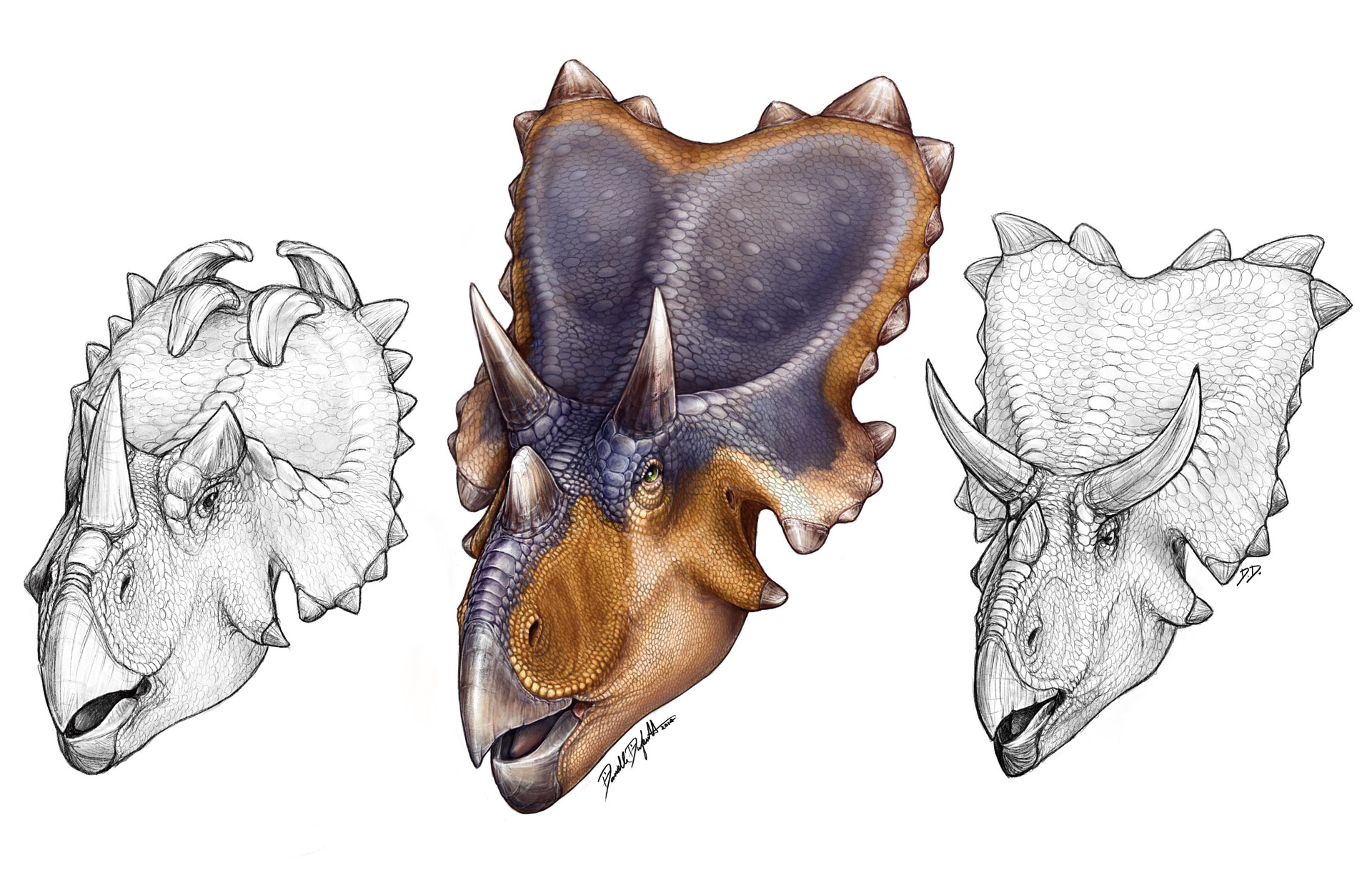
New Species of Horned Dinosaur Mercuriceratops Gemini
Mercuriceratops gemini (center) compared to horned dinosaurs Centrosaurus (left) and Chasmosaurus (right), also from the Dinosaur Park Formation of Alberta, Canada. Credit: Danielle Dufault
A newly published study details the discover of a new species of dinosaur named Mercuriceratops Gemini, which was approximately 6 meters long and lived about 77 million years ago during the Late Cretaceous Period.
Cleveland, Ohio – Scientists have named a new species of horned dinosaur (ceratopsian) based on fossils collected from Montana in the United States and Alberta, Canada. Mercuriceratops (mer-cure-E-sare-ah-tops) gemini was approximately 6 meters (20 feet) long and weighed more than 2 tons. It lived about 77 million years ago during the Late Cretaceous Period. Research describing the new species is published online in the journal Naturwissenschaften.
Mercuriceratops (Mercuri + ceratops) means “Mercury horned-face,” referring to the wing-like ornamentation on its head that resembles the wings on the helmet of the Roman god, Mercury. The name “gemini” refers to the almost identical twin specimens found in north central Montana and the UNESCO World Heritage Site, Dinosaur Provincial Park, in Alberta, Canada. Mercuriceratops had a parrot-like beak and probably had two long brow horns above its eyes. It was a plant-eating dinosaur.
“Mercuriceratops took a unique evolutionary path that shaped the large frill on the back of its skull into protruding wings like the decorative fins on classic 1950s cars. It definitively would have stood out from the herd during the Late Cretaceous,” said lead author Dr. Michael Ryan, curator of vertebrate paleontology at The Cleveland Museum of Natural History. “Horned dinosaurs in North America used their elaborate skull ornamentation to identify each other and to attract mates—not just for protection from predators. The wing-like protrusions on the sides of its frill may have offered male Mercuriceratops a competitive advantage in attracting mates.”
“The butterfly-shaped frill, or neck shield, of Mercuriceratops is unlike anything we have seen before,” said co-author Dr. David Evans, curator of vertebrate palaeontology at the Royal Ontario Museum. “Mercuriceratops shows that evolution gave rise to much greater variation in horned dinosaur headgear than we had previously suspected.”
The new dinosaur is described from skull fragments from two individuals collected from the Judith River Formation of Montana and the Dinosaur Park Formation of Alberta. The Montana specimen was originally collected on private land and acquired by the Royal Ontario Museum. The Alberta specimen was collected by Susan Owen-Kagen, a preparator in Dr. Philip Currie’s lab at the University of Alberta. “Susan showed me her specimen during one of my trips to Alberta,” said Ryan. “I instantly recognized it as being from the same type of dinosaur that the Royal Ontario Museum had from Montana.”
The Alberta specimen confirmed that the fossil from Montana was not a pathological specimen, nor had it somehow been distorted during the process of fossilization,” said Dr. Philip Currie, professor and Canada research chair in dinosaur paleobiology at the University of Alberta. “The two fossils—squamosal bones from the side of the frill—have all the features you would expect, just presented in a unique shape.”
“This discovery of a previously unknown species in relatively well-studied rocks underscores that we still have many more new species of dinosaurs to left to find,” said co-author Dr. Mark Loewen, research associate at the Natural History Museum of Utah.
This dinosaur is just the latest in a series of new finds being made by Ryan and Evans as part of their Southern Alberta Dinosaur Project, which is designed to fill in gaps in our knowledge of Late Cretaceous dinosaurs and study their evolution. This project focuses on the paleontology of some of oldest dinosaur-bearing rocks in Alberta and the neighbouring rocks of northern Montana that are of the same age.
Publication: Michael J. Ryan, et al., “A new chasmosaurine from northern Laramidia expands frill disparity in ceratopsid dinosaurs,” Naturwissenschaften, June 2014, Volume 101, Issue 6, pp 505-512; doi:10.1007/s00114-014-1183-1
Source: Cleveland Museum of Natural History
Image: Danielle Dufault
© Science Discovery 2012 | Blogger Template by Enny Law - Ngetik Dot Com - Nulis